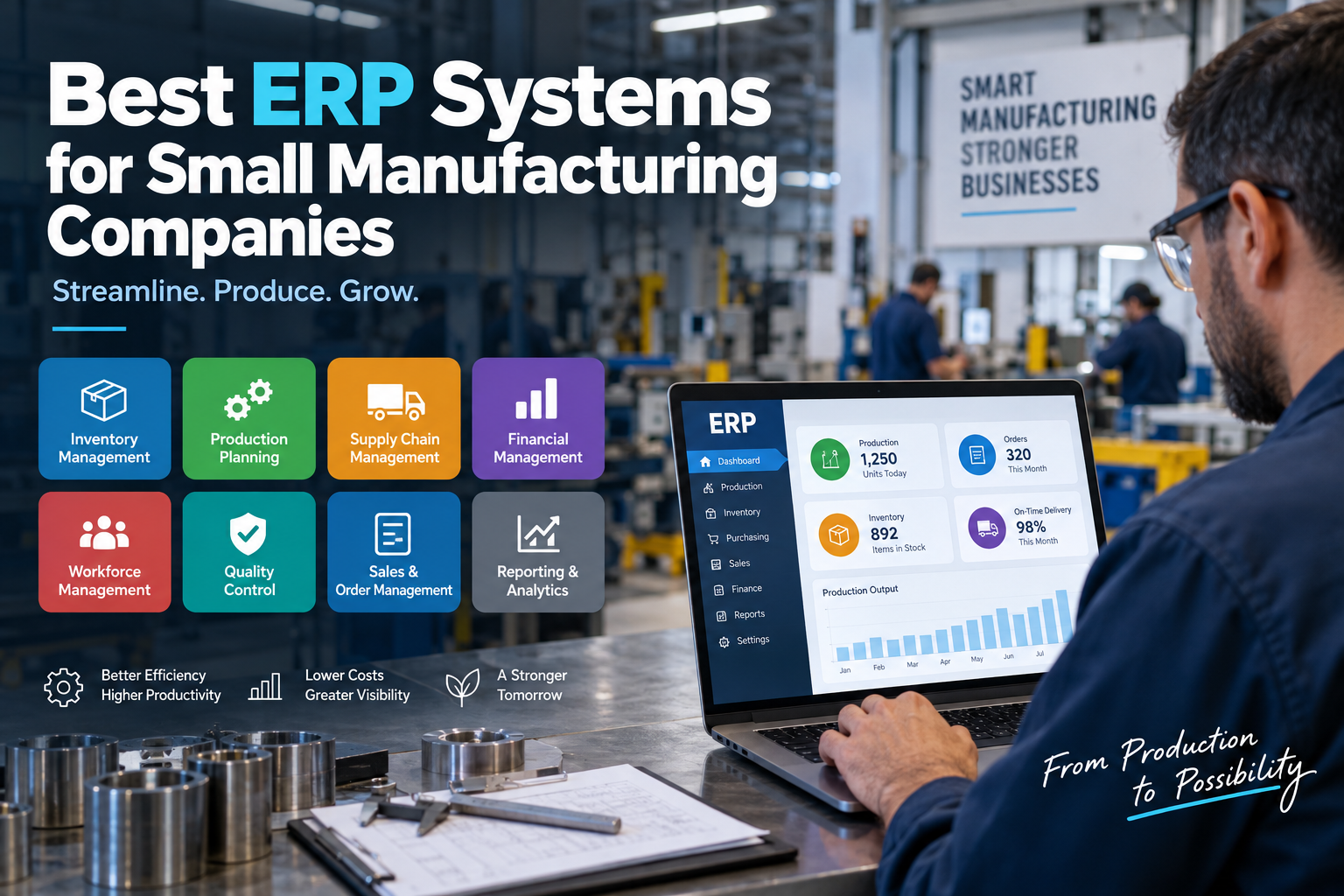
Running a small manufacturing business often means balancing production schedules, inventory, purchasing, labor, quality control, customer orders, and finances—all at the same time. As a company grows, managing these processes with spreadsheets and disconnected software can become increasingly difficult.
That is where an enterprise resource planning (ERP) system can make a major difference.
The best ERP systems for small manufacturing companies bring core business operations into one centralized platform. Instead of maintaining separate systems for accounting, inventory, purchasing, production, and sales, manufacturers can use an ERP platform to connect these processes and gain a clearer view of the business.
But choosing the right system isn’t always straightforward. Manufacturing companies have different requirements depending on their size, industry, production method, and growth plans.
This guide explains what to look for in manufacturing ERP solutions, including important considerations for food manufacturers and smaller manufacturing companies.
What Is a Manufacturing ERP System?
A manufacturing ERP system is business management software designed to coordinate the major activities involved in running a manufacturing operation.
A typical system may connect:
- Inventory management
- Production planning
- Purchasing and procurement
- Sales orders
- Accounting and financial management
- Supply chain management
- Quality control
- Warehouse operations
- Workforce management
- Reporting and analytics
- Customer relationship management
The biggest advantage is connectivity. When information is shared between departments, employees can work from the same data instead of relying on manually updated spreadsheets or disconnected applications.
For example, when a customer places an order, an ERP system can help determine whether the required inventory is available, whether additional materials need to be purchased, and whether production capacity is sufficient to meet the requested delivery date.
Why Small Manufacturers Need ERP Software
ERP software was once associated primarily with large corporations with large IT departments and substantial software budgets. Modern cloud-based platforms have changed that.
Today, smaller manufacturers can find ERP solutions that are designed around their budgets, staffing levels, and operational requirements.
For a small manufacturing company, the right ERP can help address several common challenges.
1. Better Inventory Visibility
Inventory problems can quickly become expensive.
Having too much inventory ties up working capital and increases storage costs. Having too little can cause production delays and missed customer deadlines.
An ERP system can provide real-time visibility into raw materials, work-in-progress inventory, finished goods, and purchasing requirements.
2. Improved Production Planning
Production planning becomes increasingly complicated as product lines, orders, machines, and employees increase.
Manufacturing ERP software can help production managers coordinate work orders, bills of materials, routings, production schedules, and material requirements.
This can make it easier to identify bottlenecks before they become major problems.
3. More Accurate Costing
Manufacturers need to understand how much it actually costs to produce their products.
ERP systems can combine material costs, labor, overhead, and other production expenses to provide better visibility into product profitability.
That information can be useful when setting prices, evaluating product lines, or deciding whether to outsource certain operations.
4. Fewer Manual Processes
Small businesses frequently rely on spreadsheets for inventory, purchasing, production schedules, and financial tracking.
Spreadsheets can be useful, but they become difficult to manage when multiple employees are entering and changing information.
An ERP system can automate many routine processes and reduce duplicate data entry.
Best ERP Systems for Small Manufacturing
There is no single ERP platform that is automatically the best choice for every manufacturer.
The right option depends on factors such as the company’s industry, production method, number of employees, number of locations, budget, and future growth plans.
When evaluating the best ERP system for a small manufacturing company, consider the following capabilities.
Manufacturing Management
Manufacturing functionality should be one of the first things to evaluate.
Look for features such as:
- Bills of materials (BOMs)
- Work orders
- Production scheduling
- Material requirements planning
- Shop-floor management
- Work-in-progress tracking
- Production costing
- Capacity planning
A company that builds products to customer specifications may need different functionality from a manufacturer producing standardized products in large batches.
Inventory Management
A good manufacturing ERP should provide more than a simple inventory count.
Useful capabilities include:
- Multi-location inventory
- Lot and batch tracking
- Serial number tracking
- Reorder points
- Inventory forecasting
- Barcode scanning
- Warehouse management
- Stock transfers
- Cycle counting
These features can help manufacturers maintain the right inventory levels while improving operational visibility.
Purchasing and Supplier Management
Purchasing is closely connected to production.
ERP software should ideally allow purchasing teams to monitor suppliers, purchase orders, lead times, pricing, and incoming materials.
Some systems can also automatically generate purchase recommendations based on inventory levels and production requirements.
Financial Management
Manufacturing and accounting should not operate as completely separate functions.
Integrated financial tools can connect sales, purchasing, inventory, production, accounts payable, and accounts receivable.
This can provide management with a clearer picture of cash flow, expenses, margins, and profitability.
Reporting and Analytics
Data is only valuable when managers can use it to make decisions.
Look for ERP platforms that provide customizable dashboards and reports covering metrics such as:
- Production efficiency
- Inventory turnover
- Order fulfillment
- Material costs
- Labor costs
- Gross margins
- Purchasing performance
- On-time delivery
- Production downtime
Best ERP for Food Manufacturing
Food manufacturers have some requirements that differ significantly from other types of manufacturers.
If you’re searching for the best ERP for food manufacturing, food safety, traceability, inventory control, and production planning should receive particular attention.
Batch and Lot Traceability
Food companies often need to know exactly where ingredients came from and where finished products went.
A suitable ERP should support lot and batch tracking throughout the supply chain.
If a problem occurs with a particular ingredient or production batch, traceability can help the company identify affected products and customers more quickly.
Expiration and Shelf-Life Management
Food products and ingredients may have limited shelf lives.
ERP software can help manufacturers monitor expiration dates and use inventory management strategies such as first-expired, first-out (FEFO).
This can reduce waste and help manufacturers manage products more efficiently.
Recipe and Formula Management
Food manufacturers often use recipes or formulas instead of traditional bills of materials.
The ERP should make it possible to manage ingredients, quantities, substitutions, yields, and production requirements.
The system should also make it easy to update formulas while maintaining appropriate controls over changes.
Quality Management
Quality control is particularly important in food manufacturing.
Depending on the operation, an ERP may need to support:
- Quality inspections
- Ingredient testing
- Production testing
- Certificates of analysis
- Nonconformance tracking
- Corrective actions
- Supplier quality
- Batch records
Manufacturers should also verify that the ERP can support their specific regulatory and compliance requirements.
Manufacturing ERP Solutions: Cloud vs. On-Premises
One of the first decisions a manufacturer may face is whether to deploy an ERP system in the cloud or on company-owned infrastructure.
Cloud ERP
Cloud-based ERP software is hosted by the software provider and accessed through the internet.
Potential advantages include:
- Lower upfront infrastructure costs
- Automatic software updates
- Easier remote access
- Simplified maintenance
- Faster deployment
For many small and midsize manufacturers, cloud ERP can be attractive because the company doesn’t need to maintain its own ERP servers.
On-Premises ERP
With an on-premises deployment, the company typically hosts and manages the software infrastructure itself.
This approach can provide greater control over the IT environment, but it may also require additional hardware, technical expertise, maintenance, and security management.
The right approach depends on the company’s requirements and IT resources.
ERP Solutions for Manufacturing Industries
Manufacturing is not one uniform industry. Different manufacturing environments can require very different ERP capabilities.
Discrete Manufacturing
Discrete manufacturers produce identifiable products or components.
Examples include:
- Machinery
- Electronics
- Automotive components
- Industrial equipment
- Furniture
These businesses may place a strong emphasis on bills of materials, work orders, routings, and production scheduling.
Process Manufacturing
Process manufacturers typically produce goods by mixing, blending, heating, or otherwise processing ingredients and raw materials.
Examples include:
- Food and beverage
- Chemicals
- Pharmaceuticals
- Cosmetics
These companies may require stronger batch management, formula management, traceability, and quality control.
Make-to-Order Manufacturing
Make-to-order businesses begin production after receiving a customer order.
For these companies, ERP software should connect sales orders with production planning and material requirements.
Make-to-Stock Manufacturing
Make-to-stock manufacturers produce goods based on expected demand.
Forecasting, inventory planning, and production scheduling can therefore be especially important.
How Much Does Manufacturing ERP Software Cost?
ERP pricing can vary substantially.
Some vendors charge a monthly subscription based on users or modules, while others use different pricing structures. Implementation, customization, training, integrations, and data migration can also affect the total cost.
Instead of comparing software based only on the subscription price, manufacturers should consider the total cost of ownership.
For example, a less expensive ERP may become more costly if it requires extensive customization or third-party software to perform essential manufacturing functions.
When comparing vendors, ask about:
- Software licensing
- Implementation
- Data migration
- Employee training
- Technical support
- Integrations
- Customization
- Hardware requirements
- Future upgrades
- Additional users and modules
How to Choose the Right ERP for a Small Manufacturing Company
Choosing an ERP system is a significant business decision. The software will often become part of the company’s daily operations for years.
A structured evaluation process can reduce the risk of choosing a system that looks good during a sales demonstration but doesn’t work well in the real production environment.
Step 1: Identify Your Current Problems
Before looking at software, document the problems you want the ERP to solve.
For example:
- Inventory inaccuracies
- Production delays
- Manual purchasing
- Poor job costing
- Limited financial visibility
- Difficult scheduling
- Lack of traceability
- Too many spreadsheets
This gives you a clear list of requirements when comparing vendors.
Step 2: Separate Essential Features From Nice-to-Have Features
Not every feature deserves equal weight.
Create two lists:
Must-have features
These are capabilities the business cannot operate without.
Nice-to-have features
These could improve operations but aren’t essential for the initial implementation.
This approach can prevent a company from paying for unnecessary functionality.
Step 3: Involve Employees Who Will Actually Use the System
ERP decisions shouldn’t be made solely by executives or the IT department.
Production managers, warehouse employees, purchasing staff, accountants, and other daily users can identify problems that may not be obvious to management.
Their input can also improve adoption after implementation.
Step 4: Request a Realistic Demonstration
Don’t ask vendors to provide a generic demonstration.
Give them an example based on your actual business.
For example:
A customer orders 500 units of Product A. The product requires three raw materials. One material is below its reorder point. Production requires two operations and a quality inspection before shipment.
Then ask the vendor to demonstrate how the system handles the complete process.
This can reveal much more than a standard feature presentation.
Step 5: Evaluate Implementation
A powerful ERP system can still fail if implementation is poorly managed.
Ask the vendor:
- Who manages implementation?
- How long does implementation typically take?
- How is data migrated?
- What training is included?
- What happens if implementation falls behind schedule?
- What support is available after launch?
Implementation should be treated as a business project rather than simply a software installation.
Common ERP Mistakes Small Manufacturers Should Avoid
Choosing Based Only on Price
The cheapest ERP isn’t necessarily the least expensive option.
If the software cannot handle your manufacturing processes, you may end up paying for custom development, additional applications, or manual workarounds.
Buying Too Much Software
The opposite problem is also common.
A small company may purchase a complex enterprise platform with dozens of modules that employees never use.
A simpler system that matches the company’s actual needs can sometimes deliver better results.
Ignoring Integration
Manufacturers often use other software for payroll, e-commerce, shipping, customer management, or specialized production equipment.
Before selecting an ERP, determine whether it can integrate with the systems you already depend on.
Underestimating Employee Training
Even an excellent ERP system won’t provide much value if employees don’t understand how to use it.
Training should be included in the implementation plan from the beginning.
Questions to Ask an ERP Vendor
Before signing a contract, ask potential vendors questions such as:
- Does the system support our specific manufacturing process?
- Can it manage bills of materials and work orders?
- Does it support lot and serial number tracking?
- Can it handle multiple warehouses?
- How does production scheduling work?
- What inventory forecasting tools are included?
- Does the platform integrate with our accounting software?
- How are software updates handled?
- What implementation services are included?
- What will our total cost be during the first three years?
- Can the system scale as our company grows?
- Can we export our data if we eventually change platforms?
The answers can help separate a genuinely suitable ERP platform from one that simply has an impressive list of features.
Final Thoughts
The best ERP systems for small manufacturing businesses are not necessarily the systems with the longest feature lists. The best solution is usually the one that fits the company’s manufacturing processes, budget, employees, and growth strategy.
For manufacturers, important capabilities include production planning, inventory management, purchasing, costing, financial management, reporting, and integration.
Food manufacturers should place additional emphasis on batch and lot traceability, shelf-life management, recipe or formula control, and quality management.
Ultimately, manufacturing ERP solutions should make the business easier to manage—not add another layer of complexity.
Before making a purchase, define your requirements, involve the people who will use the software, test realistic workflows, and calculate the total cost of ownership. A thoughtful evaluation can help a small manufacturer select an ERP platform that supports both current operations and future growth.
